

Specializing in Credit Union & Small Claims Support
Reliable Process Serving Across Mid-Michigan & Northern Michigan
Fast, professional service with real-time updates. Trusted by law firms, businesses, and individuals since 2007.
Insured & Bonded
Court Officer
Special Deputy Sheriff
Process Serving & Judgment Recovery
We provide fast, reliable process serving with real-time job updates through ServeManager. From high-volume medical and financial debt to landlord/tenant and small claims cases, we maintain a high service success rate while keeping communication clear and consistent.
We also specialize in judgment recovery through Orders to Seize. As a Court Officer, we are authorized to seize assets and coordinate auctions to help recover your money judgment. Whether you’re just starting the process or already have an Order to Seize in place, we can step in and handle the next steps.
Due to the rural nature of our coverage area, phone availability may be limited. For questions or to schedule a call, please email [javascript disabled].
Experience You Can Trust
- Insured & Bonded
- Bachelor of Arts / Criminal Justice 1998
- Serving process since 2007
- Licensed PI since 2009
- Court Officer since 2016
- Special Deputy Sheriff (Roscommon County) since 2021
- Special Deputy Sheriff (Gladwin County) since 2025
Services You Can Rely On
Comprehensive legal support—from document service to locating individuals and recovering judgments.
Professional delivery of legal documents with accurate, timely completion and proper documentation.
Locating hard-to-find individuals using verified data sources and investigative methods.
Fast, compliant delivery of eviction and landlord/tenant notices.
Assistance with collecting on court-awarded judgments, including Orders to Seize when applicable.
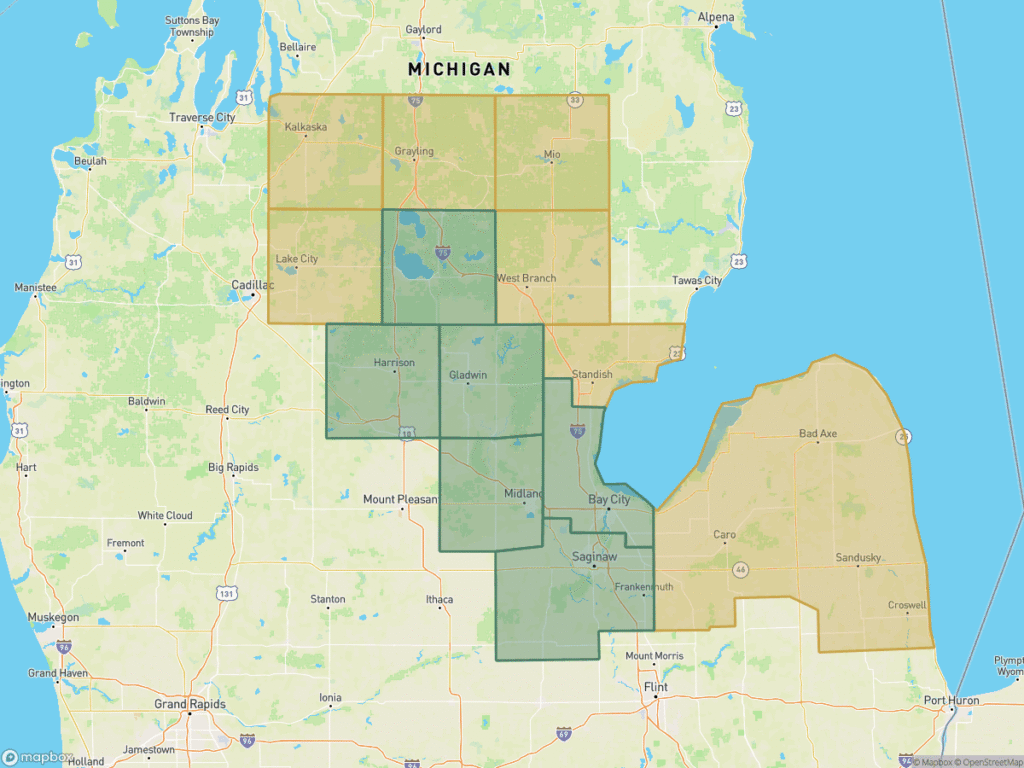
Mid & Northern Michigan Service Map
We provide expert legal support throughout Central and Northern Michigan, with a focus on our primary coverage counties. Extended areas are available with prior approval.
Primary: Great Lakes Bay & Mid-Michigan
- Bay
- Clare
- Gladwin
- Midland
- Roscommon
- Saginaw
Extended: Northern Michigan & The Thumb
Prior agreement required
- Arenac
- Crawford
- Kalkaska
- Missaukee
- Ogemaw
- Oscoda
- The Thumb
Why Choose DARE Process Serving
- Regional Authority: Deeply familiar with courts and procedures from the Tri-Cities to Northern Michigan.
- Rapid Response: Priority attempts and streamlined service to meet your deadlines.
- Tech-Integrated: Real-time status updates and verified proof of service via ServeManager.
- Discreet Execution: Professional handling of sensitive documents with absolute care.
- Upfront Rates: Transparent, flat-fee pricing with no hidden surcharges.
Shane is a diligent and caring person who follows the letter of the law. I’ve used his services many times and never had a single complaint from ANY of the parties involved. Would highly recommend!
Cadentz L.
Start a Request or Get in Touch
Before you reach out:
For new service requests, please use the Order Service form or log in to your account.
If you’re submitting an inquiry below, please include:
Issuing court, service address(es), deadline, number of individuals and documents to be served.
Email: [javascript disabled]
Phone: 989-486-2168
Hours: M-F 8am-5pm EST
Mail Paperwork To:
2255 Tower Hill Rd, #758
Houghton Lake, MI 48629
Pricing and Fees
Service Fees
- Service Fee – $26.00
- Mileage – Round trip at $1.05/mile
- Postal Verification – $10.00/per submission, ***BILLED AT MY DISCRETION***
- Bad Address Fee – $10.00/address + mileage
- Verification Fee – $10.00 + mileage, utilized for unknown addresses, verified residential address when the individual is served at another location, or submission for alternate service
- Performing the Certified Mailing – $13.00 + actual postage fees
- Performing the Certificate of Mailing – $13.00 + actual postage fees
- For each global positioning service verification, $5.00 per address
- For each photo verification, $5.00 per address
Skip Tracing Fees
- Basic Skip Trace- $25 – This will show hits for a residence where the debtor may live. (per individual)
- Advanced Skip Trace- $50 – This will show hits for residences, associates and family members, which might be where the debtor is living. (per individual)
Eviction Fees
- $40.00 – service fee
- $10.00 – GPS/Photo
- $1.05/Mile
- $65.00 – special notice (client requested)
- $65.00 – reschedule fee for serving/posting the Order (when appropriate)
- $65.00 – when people are living on a property or when law enforcement is called.
Notary Fee
$25.00, for any paperwork that needs a notary, please send a note first explaining what type of paperwork needs to be served.
Note
If my fees are not recognized by the venue/Court where they are filed, then I will amend paperwork, but the client is still responsible for paying the total invoice.
All paperwork that must be served personally and not via Alternate Service is billed at the same structure as above, except that after the third attempt any continued attempts are re-billed based on the rate previously established. An example is a Notice of Judgment Lien.
Small Claims Court Overview
Before You File
Here are some things to consider prior to filing a small claims case:
- Consider the chances of winning your case
- Think about whether out of court options might work, such as a settlement or mediation
- Is the Debtor collectible (do they have funds/resources to pay you even if you win?)
- Filing and service fees are non-refundable if you lose your case
- Small claims cases can only be filed for a money judgment. For example, you cannot ask for a certain object to be returned, for this you must file a claim and delivery.
Filing Your Small Claims Case
When filling out the small claims’ paperwork, (form DC84) leave the signature line blank. This signature must be witnessed in front of a notary public or a court clerk.
File your claim with the district court clerk (small claims are handled in district court), either where the dispute took place or where the defendant lives or works. If, for example, you’re a landscaping company suing a client for an unpaid bill, you can file your case in the district where the dispute arose – in this case where you did the landscaping – or in the district where your client lives or works.
When you file your claim, the court requires you to pay a filing fee. The fee varies depending on the amount you are suing for. The filing fee is:
- $25 for claims up to $600
- $45 for claims over $600 up to $1,750 and
- $65 for claims over $1,750 up to $7,000*
THE FILING FEES DO NOT APPLY TO THE SERVICE FEES. SERVICE FEES ARE A SEPARATE FEE.
* The small claims court can’t award more than $7,000. If you have a case you think is worth more than $7,000, you can still file it in Small Claims Court. But if you do, you lose the right to any judgment amount over $7,000. Once a judge or magistrate has decided on a case, it cannot be filed again.
The court clerk will give your case a number, assign a judge or magistrate and complete the notice of hearing, which will state when and where the hearing on your case will be.
When you have a case in small claims court, a district court judge, or an attorney magistrate (no jury) will hear the case and decide on it. If a judge hears your case, you can’t appeal the decision. If a magistrate hears your case, you can appeal within seven days of the judgment. The case is then heard by the District Court Judge.
If you are the Plaintiff and win your case, you might be able to get your filing and service fees back as part of the costs the court awards you.
Settling Out of Court
The defendant could offer to settle the case before you go to court. If you and the defendant reach an agreement, document it in writing and have both parties sign it. Ask the judge to enter it as the judgment in the case. Use the Judgment, Small Claims (form DC85)
If you reach an agreement, you can also dismiss the case, without having your agreement entered as a judgment. To do this, you can fill out a Dismissal (form MC09). Call the court clerk’s office where you filed your case to ask about how to file this form.
If you dismiss the case instead of getting a judgment, and the defendant doesn’t follow the agreement, you must file a new case.
If you enter a consent judgment (defendant accepts responsibility) instead, you can use judicial methods of collection, such as garnishment, to get the money you were awarded (form DC85).
The Process of Serving Paperwork
My Responsibilities
While every effort will be made to attain three attempts within three weeks of receiving the paperwork (and payment), prioritizations will take place based on current workload, hearing dates, expiration dates, etc. but will not take more than six weeks to attain the attempts at a good address. Delays or wait times from postal verification or bad addresses may occur.
If paperwork is not received with enough time to make all attempts, a new hearing date must be scheduled; the remaining attempts will be made for a total of three at a good address.
If service is needed around commonly recognized national holidays, availability may be limited.
Paperwork may be outsourced to another court officer and/or process server to meet the required service dates or location.
The service fee includes three (3) attempts, a morning, afternoon, and evening at the ‘good’ address. If you require attempts for a specific time of day or additional attempts, a premium may be charged (which is NOT taxable back to the individual/defendant and is an out-of-pocket expense to the Plaintiff). Weekend attempts are not guaranteed.
Client Responsibilities
Clients are required to pre-pay a flat rate of $40. This fee includes up to three (3) attempts at the good address, photo, and GPS verifications. If the statutory service of process fee and billable mileage from the original address is higher than $40, the invoice will be adjusted to reflect the higher cost, and the client will have to pay this before attempts are made.
If an incorrect address is determined and the client provides a new or multiple addresses to be attempted, the client agrees to pay the postal verifications that I submit for each new address.
All known information about a defendant is requested with initial paperwork, this includes (potential alternate addresses, places of employment, vehicle information, spouses, etc.)
Please provide all street address information including details such as: St, Ave, Rd, Way, Ln, Cir, Dr, Ct, etc.) and cardinal direction (N, S, E, and W). Many addresses are similar and vary from tax records, street signs and Google/MapQuest (i.e. 123 First Street, 123 1st Street or 123 First Avenue). Incorrect addresses will be billed accordingly.
*If a business is the defendant, and the Registered Agent is to be served, this information must be provided. If a “person in charge” of the office can be served based on the structure of the organization, that individual will be served on the first attempt.
If the client has been informed of a bad or unknown address, the client must:
- Provide all new addresses for attempts at one time (not piecemeal).
- Pay for submission of all postal verifications which will be based on the newly established addresses.
- If there is a question regarding the validity of an address, all attempts will be placed on hold until the client can provide the necessary confirmation.
- The client agrees to pay for the adjusted invoice which will include the Alternate Service posting and any mailings fees before attempts are continued at the address in question.
- Pay the readjusted final invoice before the final Proof of Service or Affidavit of Non-Service is filed.
HOLDING PAPERWORK: After I provide the client with an update indicating a bad address or other info, the client needs to respond to me with their intentions within 1 month or the case will be closed on my end. If updates are provided after 1 month, then print fees may apply if the client would like me to continue working on the case.
All clients must provide their contact phone number and physical residential address, even if a PO Box is utilized for mailing purposes, before attempts are made on the case.
Skip Tracing
What happens if you can’t find the person you need to serve?
Definition of skip tracing: The process of finding someone who is intentionally avoiding detection. It can be used to locate individuals who are missing, owe debts, or have important information.
If the provided service address is a bad address, skip tracing services may be provided to assist in locating the individual. An additional fee is charged, and payment is required in advance.
- Basic Skip Trace- $25 – This will show hits for a residence where the debtor may live. (per individual)
- Advanced Skip Trace- $50 – This will show hits for residences, associates and family members, which might be where the debtor is living. (per individual)
If I am working on serving your case, after running the skip tracing database search, an additional $40 is billed. This covers two verifications or incorrect addresses. DEPENDING ON WHERE THE ATTEMPTS WILL BE MADE, THESE FEES MAY VARY. All of these fees will be adjusted to reflect statutory fees when available.
This is not just running database searches; this is data mining and connecting dots.
Alternative Service
If after making three attempts at the ‘good’ address and the individual has not been served, a Motion and Verification for Alternate Service (form MC303) and Order for Alternate Service (form MC304) will be provided, if needed. These forms have the information regarding the service attempts and you are responsible for filing them with Court. You may need to pay a $20.00 Motion fee to Court at the time of filing this paperwork. If the order for Alternate Service is granted, I will need a copy of the filed Motion and Order to post/tape on the individual’s residence and if also needed, I will manage the associated mailings which will be determined by the Court. Please send me the paperwork via ServeManager, email or mail. The Court will determine if the paperwork needs to be mailed first class and/or sent Certified mail. Each of these additional steps have associated Statutory fees that are billed to you if I am responsible for completing the tasks.
***A premium fee of $100.00 will be charged to post Alternate Service paperwork if it is received 7 days or less before the last day to post the paperwork.
If Alternate Service is needed, any and all outstanding fees including those for posting the paperwork will be paid in advance before the Verification of Process Server is sent to the Plaintiff/attorney.
Proofs of Service (POS)
After the paperwork has been served, the Proof of Service will be filed with the issuing Court and an electronic image will be provided to the client.
All POS/Affidavits/Verifications will be held until full payment has been made on the case.
The Hearing
If you sue someone for money and receive a judgment against that person, you are called the “judgment creditor” and the person against whom you receive the judgment is called a “judgment debtor.”
If the judgment debtor has the money and is present at the trial, s/he may pay at that time. If that happens, file a Certificate of Satisfied Judgment (form MC17) and file it with the clerk.
The judgment creditor may ask the judge to order a payment plan if the judgment debtor is at the hearing but can’t pay the full judgment. Both parties must agree to the payment plan. The debtor can request a payment plan anytime by filing a motion for installment payments (form MC15).
If the judgment debtor was not present at the trial, the court will send a copy of the judgment to the debtor. The judgment will order the debtor to pay you in full within 21 days or they must disclose to the creditor and the court where s/he works and the location of his/her bank accounts.
If the case involved a traffic accident, the judgment creditor can ask the court for an abstract of judgment. This judgment will suspend the judgment debtor’s Michigan driver license until s/he pays the judgment. There is a required 30 day waiting period after the judgment date until you can get an abstract of judgment. To file this abstract, the judgment creditor will need to provide the judgment debtor’s full name, date of birth, and Michigan driver’s license number to the court clerk to file. There is no filing fee associated this this request.
Collecting on Judgments
Collect Before the Judgment Expires
A judgment from a small claims case expires six years after it is issued. If the judgment is not collected before it expires, you lose the legal right to collect it. This is called the statute of limitations. The clock on the expiration date is stopped/tolled while the debtor is paying a judgment in installments.
If a judgment expires, your legal options for collecting money are no longer available. To continue collecting on a judgment before the expiration date, the judgment must be renewed. A motion to renew a judgment must be filed before the original judgment expires. A renewal of a judgment extends the judgment for the same period as the original judgment. See Michigan Compiled Laws, MCL 600.2903 and 600.5809 (form MC390).
Using Court Processes to Collect the Judgment
If the judgment debtor doesn’t pay the judgment as ordered, the creditor may attempt to collect the judgment through a garnishment or seizure of property. (Garnishment is not an option if the debtor is making payments.)
Garnishment
Garnishment is a court procedure that allows you to collect the money owed to you by taking it from the judgment debtor’s wages, bank account, or another source (such as income tax refunds).
There are three types of garnishment:
- periodic,
- non-periodic, and
- income tax intercept.
How to file for a garnishment
A waiting period of 21 days must pass after the small claim’s judgment was signed before a request for garnishment may be issued. To file a garnishment, contact the court clerk for the proper forms. Instructions are provided with the forms. After the request for garnishment forms are completed, they must be filed with the district court that handled the judgment and a $15 file fee must be paid.
A non-periodic garnishment is in effect for 182 days. The garnishment expires on the 183rd day after the court issued it. A new writ of garnishment must be requested if it expires and may only be used once.
A periodic writ of garnishment (form MC 12) is used to garnish the judgment debtor’s wages, rent payments, land contract payments, or other debt that is paid to the judgment debtor on a periodic basis. A periodic garnishment is valid until the expiration date on the writ or until the judgment, interest, and costs are paid off, whichever occurs first.
A non-periodic writ of garnishment (form MC 13) is used to garnish the judgment debtor’s bank account or other property. Once money has been garnished under the non-periodic writ, the writ is no longer valid. If there is a remaining balance due on the judgment, you must get another writ to collect more money. A non-periodic garnishment is a one-time garnishment. It’s usually applied to a bank account or state tax refund. It’s only good for the moment it’s served on the garnishee. So, if the debtor’s checking account has $100.00 in it when the writ is served you will get $100.00 toward the judgment. If the debtor deposits $1,000.00 the day after the writ is served, you will not get any additional money.
An income tax writ of garnishment (form MC 52) is used to intercept the judgment debtor’s income tax refund. Once the tax refund has been intercepted by the Department of Treasury, the writ is no longer valid. If there is a remaining balance due on the judgment, you must get another writ to collect more money.
Follow the instructions provided with the garnishment forms depending on the type of garnishment requested. The garnishee (employer) must be served within 182 days from the date the writ is issued.
There is a $35 disclosure fee for a garnishment of periodic payments and income tax refund.
When can I collect from the garnishment?
The garnishee has 14 days after the writ is served to let the judgment creditor, the court, and the judgment debtor know if any money is available for garnishment. This information will be provided on the Garnishee Disclosure, (form MC 14).
If money is available, it will be withheld from the judgment debtor right away. However, this money will be held for 28 days to allow the judgment debtor time to object. If the judgment debtor files no objections with the court, the withheld money will be automatically sent to the judgment creditor after 28 days. If the garnishment is for periodic payments, money will continue to be sent to you as payments become due until the writ expires.
How much can I collect?
The judgment creditor may collect the amount stated in the judgment plus any interest that accumulates during the time the judgment debtor pays off the judgment. For help in calculating interest rates, contact a certified public accountant or a bank.
Several types of income are exempt from garnishment, including Social Security, Aid to Families with Dependent Children, General Assistance, unemployment compensation, and Workers’ Compensation benefits. Federal law restricts garnishment of earnings (including payments pursuant to a pension or retirement program) to 25% of disposable earnings per week, or 30 times the federal minimum wage, whichever is less. When a debtor’s wages are garnished, only a certain amount can be taken. It is never more than 25% of the debtor’s earnings after taxes.
Landlord / Tenant Matters (Gladwin County Only)
Notice of Eviction
- Requesting only possession of the dwelling:
- The Summons will be served / posted at the residence.
- The paperwork needs to be served/posted (3) days prior to the hearing.
- Requesting a money judgment:
- Each named defendant/tenant should be served personally to avoid potential issues.
- The paperwork can/will be posted at the residence on the 3rd attempt.
- If all named defendant/tenant(s) are not personally served, the money judgment might not be granted. This is at the discretion of the court.
- The paperwork needs to be served/posted (3) days prior to the hearing.
Notice of Eviction (Money Judgment)
Under Michigan’s eviction process, the required notice and related paperwork must be mailed to the tenant(s) in advance of any personal service efforts. When a tenant vacates the property before personal service can be completed, a money judgment generally becomes impractical unless a new, valid address is available for service.
For that reason, it is important for the Plaintiff to understand that I cannot compel a tenant to answer the door or accept service. If the Plaintiff intends to pursue a money judgment, they should provide any additional address information or alternative locations for service (e.g., place of employment, forwarding address, mailing address on file, or other reliable contact/location information). Without updated service information, my attempts are limited to the last known address, and successful service cannot be guaranteed.
In cases where a money judgment is requested, allowing additional time to complete service is often beneficial, particularly when the tenant may be in the process of moving or has already relocated.
The most significant challenge in landlord-tenant matters is that the Plaintiff’s initial mailed notice typically advises the tenant to either pay the rent or vacate. If the tenant chooses to move out in response to that notice, locating them for personal service becomes difficult, and service for a money judgment may be hindered without updated address information. In my view, this creates a procedural hurdle under the current state process.
Land Contract Forfeiture
Each named defendant/tenant must be served personally. The paperwork cannot be posted.
If any defendant/tenant(s) has not been served, a new hearing date will need to be set.
A postal verification will need to be submitted for each unserved defendant/tenant.
The new hearing date needs to account for the post office turnaround time for sending the postal verification back, for the paperwork to be served (10) days prior to the hearing date and the required mailings established by the judge. These types of situations require Alternate Service as a means to finalize the service.
Order of Eviction / Writ of Restitution:
***EMAIL IS THE BEST WAY FOR COMMUNICATION. IF A PHONE CALL IS NEEDED PLEASE PROVIDE DATES AND TIMES OF THE DAY FOR SCHEDULING OPTIONS.***
As an option, I will serve / post a notice informing the tenant(s) / occupant(s) of the date and time that the Order of Eviction will be enforced. I will need to coordinate with the Plaintiff/Attorney/Representative and communication via email is preferred. This provides the tenant(s) additional time to move as much of their belongings out of the residence to save the Plaintiff from having to allocate resources. I will assess the property and provide the client with an email update. There is a $65.00 fee associated with this service.
I will serve / post the Order of Eviction: *refer to service fees.
I will need access to the dwelling with the Plaintiff or representative, and I will clear the dwelling making sure that no individuals are still inhabiting the structure. Once the residence is cleared/vacated, I will complete the peaceful transition of possession and leave the property.
If there are individuals living on the property or they refuse to vacate the property, law enforcement will be notified to have them removed or arrested. There is a minimum $65.00 fee if this occurs.
The Plaintiff is responsible for removing the tenant’s assets / valuables and making them accessible to the tenant following all State laws and statutes.
If my presence is requested to remain on the property to satisfy a “standby”, a rate of $65.00 per hour will be assessed at 2 hour increments. All “standby” fees must be paid in advance of the service being provided and are non-refundable.
Rescheduling the enforcement of the Order of Eviction needs to take place a minimum of (3) business calendar days prior to the enforcement, not including the day of communication. If less than this amount of time is provided, a $65.00 fee will be assessed to enforce the Order on a later date, including the statutory fees to serve/post the order.
***I DO NOT PROVIDE LABOR OR SCHEDULING OF ANY KIND FOR PHYSICAL CLEANOUTS***
Billing
Payment must be made in advance for the full-service fee (check or electronic payment) and there will be no refund. Attempts for service will not start until the payment has been received. This also applies to a job that has been paid for and then cancelled before attempts have been made. In cases where the defendant contacts the plaintiff or they pick the paperwork up from Court without being personally served by me, the full-service fee is still charged.
Paperwork 10 pages and less are printed at no cost. Paperwork exceeding 10 pages is billed at $0.25/page for all pages printed. All uploaded paperwork must be normal size of 8.5 x 11; originals or high-quality copies must be uploaded. Pictures of paperwork are not acceptable.
Additional fees may be charged for services provided such as skip tracing/locating individuals, scanning, copying, printing, mailing (FedEx/UPS/USPS), phone calls, emails, physically filing paperwork, fronting fees, etc.
Online Payments
Stripe software is utilized for all electronic payments. Stripe is an American technology company based in San Francisco, California. Its software allows individuals and businesses to make and receive payments over the Internet. Stripe provides the technical, fraud prevention, and banking infrastructure required to operate online payment systems. Users of this service are not provided access to any payment information. A confirmation is received from Stripe when the process is complete. Please do not send additional confirmation messages.
Types of paperwork served
The following types of paperwork may be served: General Civil – collections/damages, Small Claims, Debtor Exam, Show Cause, Garnishment, Landlord Tenant matters (GLADWIN COUNTY ONLY)
Types of paperwork NOT served
The following types of paperwork will not be served: Family Law matters, divorce, witness subpoenas, Personal Protection Orders, short notice/turn-around paperwork, paperwork that can’t be served via Alternate Service if needed, paperwork issued outside the State of Michigan.
*I DON’T SERVE MEMBERS OF LAW ENFORCEMENT.
ServeManager (SM)
Benefits of using ServeManager
- Electronic submittal of paperwork avoids getting lost in the mail or sent to the wrong location.
- Confirmation of received paperwork
- Faster than mail and service attempts can start sooner.
- Allows for additional service time to make attempts, especially when the timeframe is short.
- The program provides real-time updates on job status.
- Information is kept safe and secure.
Communication/Updates
All attempt/service updates are sent from the ServeManager (SM) database. Check spam/junk folder if notifications are not being received.
For access to real-time updates 24/7 at your leisure, please send an email to [javascript disabled] to be setup in the database.
All case correspondence is sent through the ServeManager database. Emails sent outside of SM will receive responses through SM.
Large size files may be sent via a link through Microsoft SharePoint.
Clients will be set up in SM with a firm email and generic password. Additional staff may be added upon request. It is best to have a minimum of two accounts set up for each office.
Submitting Paperwork
All new job requests must be submitted by one of the methods below (to calculate costs and facilitate payment):
- Create a job and upload documents using the Order Service form
- Please fill out the order form and attach the paperwork. If I have already received the paperwork from Court, then just attach a non-personal photo as the attachment.
- Or, Create a job using ServeManager (existing clients only)
NOTE: If there are multiple defendants listed, specify the number of pleadings to be served in the “Service Instructions” field.
NOTE: If serving a business, specify names of ALL individuals to be served in the “Service Instructions” field. Example, the registered agent.
All jobs require payment in advance. Payment can be made by:
- Utilizing Stripe for electronic payments
- Or, mailing a check with the paperwork to:
Dare Process Serving and Investigations, LLC
2255 Tower Hill Rd., #758
Houghton Lake, MI 48629
*Please understand that payment made via check can have a delayed/negative impact on your case because of the delay in mailing and processing. All jobs are placed on hold until payment has been received.